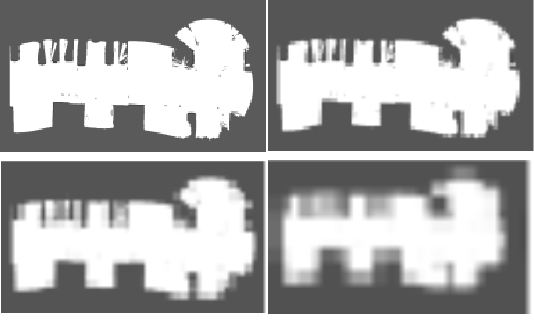
This paper addresses the problem of data representation and data storage for building large maps, under the constraints of multi-sensor real-time updates and multi-scale representation. The method called wavelet occupancy grid, based upon occupancy grids, combines advantages of a wavelet storage and a bayesian modeling. We propose a complete method to build the map and to use it directly into the compressed wavelet space. The results of a map building by the cycab autonomous robot in real conditions is then presented. It includes the results of a validation experiment in which we compare a standard occupancy grid with a wavelet occupancy grid which demonstrates the compactness of this new representation.